The Self-Controlling Enterprise
Continuous Control for Enterprises in the Age of Autonomous AI
Classic enterprise architecture controls at human speed. AI deployments change at machine speed. The Control Gradient is the control architecture that closes the gap: three layers of control, human to autonomous, running at once.
The problem in one paragraph
A classic control system has a finite number of control states: the review meetings it can hold, the architects it employs, the audits it can run in a year. An AI estate generates an unbounded number of control events: every retraining, every pipeline change, every configuration update is one more. The first quantity is fixed by headcount and calendar. The second grows with the estate. A controller that lacks the states of the system it controls does not fail occasionally. It fails structurally and repeatedly.
Organizations that hit this wall produce one of four patterns: Ghost Control, the Bottleneck, Fire Fighting, Tool Chasing. The framework exists to replace all four with one control system.
The answer in three layers
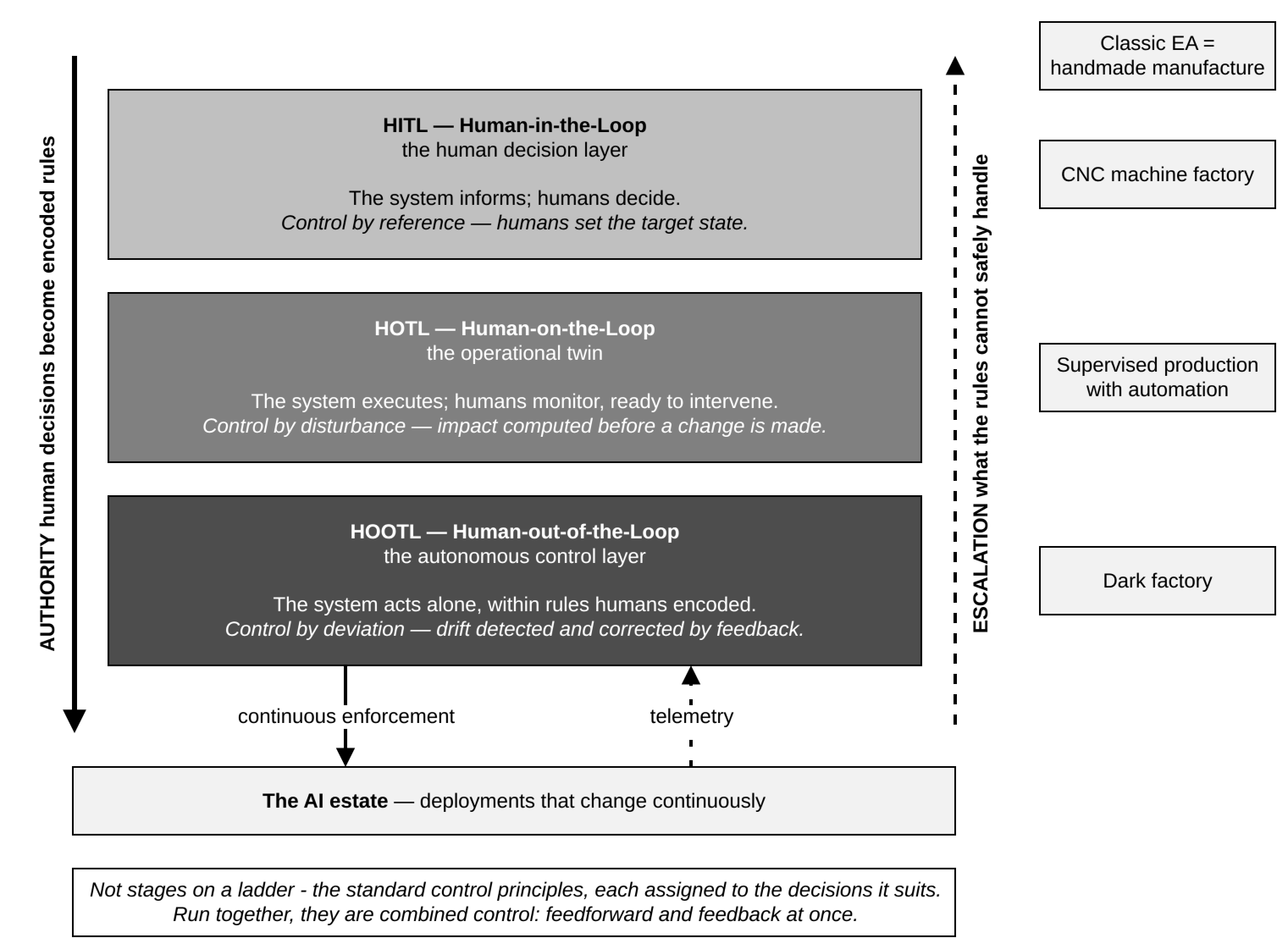
HITL keeps humans in authority over consequential decisions. HOTL runs an Enterprise Digital Twin and enforces standards as policy-as-code. HOOTL detects and corrects drift at machine speed inside a frame humans set and machines cannot change at runtime. The three are the classical control principles, reference, disturbance, and deviation, assigned to the decisions they suit.
The book
The Self-Controlling Enterprise makes the argument in twelve chapters and 25 diagrams. One argument per chapter. It stops when the argument is complete. Written for CTOs, CIOs, Enterprise Architects, and IT leaders who have been asked to do something with AI and need to keep control of it afterwards.